Dolores Huerta
Labor leader and feminist who co-founded the United Farm Workers.

via Wikipedia: Dolores Huerta · see source
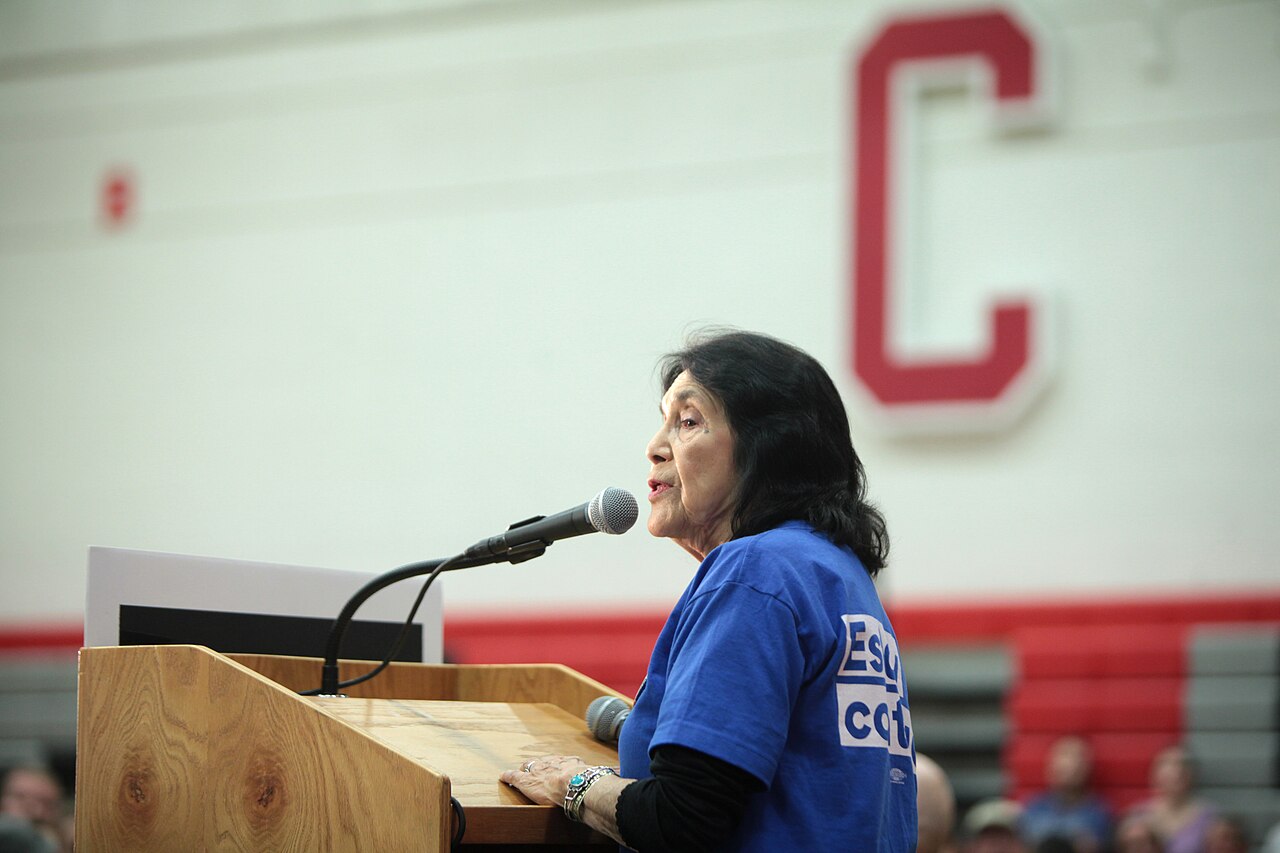
Dolores Huerta (born April 10, 1930) is an American labor leader and feminist activist. After working for several years with the Community Service Organization (CSO), she co-founded the National Farm Workers Association (NFWA) with fellow activists Cesar Chavez and Gilbert Padilla, which eventually merged with the Agricultural Workers Organizing Committee (AWOC) to become the United Farm Workers (UFW). Huerta joined Filipino leader Larry Itliong in the Delano grape strike in 1965, managing boycott campaigns on the east coast and negotiating with the grape companies to end the strike. Some credit her with inventing the UFW slogan "sí se puede".
- born
- April 10, 1930, Dawson, New Mexico
- field
- Labor organizing, feminist activism
- nationality
- American
- known_for
- Co-founding the United Farm Workers, Delano grape strike, 'sí se puede' slogan
Verified Timeline
Lore & Background
Dolores Huerta was born Dolores Fernández on April 10, 1930, in the mining town of Dawson, New Mexico. Her father, Juan Fernández, was a coal miner who belonged to the United Mine Workers. After her parents divorced when she was five, she moved with her mother and siblings to Stockton, California. Her mother supported the family working as a canner and waitress, earning $5 weekly from both jobs combined. Huerta became a teacher in rural California in 1954 but quit after a year, stating: "I couldn't tolerate seeing kids come to class hungry and needing shoes. I thought I could do more by organizing farm workers than by trying to teach their hungry children."
In 1955 she met Fred Ross of the Community Service Organization (CSO) and began attending meetings. She co-founded the National Farm Workers Association with Cesar Chavez and Gilbert Padilla in 1962. Huerta joined the Delano grape strike in 1965, organizing a wine boycott throughout California and directing boycott efforts in New York and New Jersey. She negotiated with Schenley, Gallo, and Franzia in 1966, resulting in a contract favorable to workers. When the strike ended on July 29, 1970, she helped secure a contract that increased wages, added safety rules against pesticides, created a health fund, and turned hiring over to the UFW. Huerta eventually became a strong proponent of women's rights, working with the Feminist Majority Foundation and serving as honorary co-chair of the 2017 Women's March in Washington, D.C. In 2002 she founded the Dolores Huerta Foundation, a civic advocacy organization based in Bakersfield, California.
Reader's Guide
Dolores Huerta's significance lies in her central role in the farm labor movement. She co-founded the National Farm Workers Association in 1962 with Cesar Chavez and Gilbert Padilla, which merged with the AWOC to become the United Farm Workers. During the Delano grape strike starting in 1965, she managed boycott campaigns on the east coast and negotiated with grape companies. Some credit her with inventing the UFW slogan "sí se puede." She was one of the union's lead negotiators and, according to historian Margaret Rose, "the union's first contract negotiator." Her work helped secure contracts that increased wages, added safety rules against pesticides, created a health fund, and turned hiring over to the union. Later she campaigned for women's reproductive rights and served as honorary co-chair of the 2017 Women's March. She has received the Presidential Medal of Freedom (2012), and California and Oregon have proclaimed April 10 as Dolores Huerta Day. She is portrayed by Rosario Dawson in the 2014 film Cesar Chavez and is the subject of the 2017 documentary Dolores.
Did You Know?
- Huerta's mother earned a total income of $5 weekly from two jobs: as a canner and as a waitress.
- Huerta initially described CSO founder Fred Ross as 'slightly loco' and asked the FBI to perform a background check on him before attending meetings.
- Huerta helped organize a strike on behalf of rose grafters in April 1965; after three days, the companies agreed to increase wages.
- Huerta was one of three bilingual teachers in rural California when she taught in 1954.
- Huerta's mother bought a 70-room hotel from a Japanese American family forced to relocate due to Executive Order 9066.
Roots in Working-Class California
Dolores Fernández was born in April 1930 in Dawson, New Mexico, a small mining town. Her father, a coal miner and United Mine Workers member, was uprooted by labor disputes, and the family eventually settled in Stockton, California. Her mother Alicia divorced Juan when Dolores was five; the children seldom saw their father again, though he was later elected to the New Mexico state legislature in 1938 and called a "fiery union leader" by the Los Angeles Times. In Stockton, Alicia supported the household by holding two jobs—canner and restaurant waitress—earning a combined five dollars weekly. She belonged to UCAPAWA, joined a 1937 cannery strike, opened a restaurant in 1941 that served mostly farm workers, and in 1942 bought a seventy-room hotel from a Japanese American family forced to relocate under Executive Order 9066. Dolores grew up in what she described as an integrated neighborhood of Chinese, Latino, Native American, Black, Japanese, and Italian families. Encouraged by her mother to be socially active, she spent ten years as a Girl Scout, graduated Stockton High in 1947, and earned a provisional teaching credential from Stockton College in 1953.
From Classroom to the Grape Fields
After teaching for a year in rural California in 1954, Huerta left the profession because she could not bear watching students arrive hungry and without proper shoes, concluding she could do more by organizing farm workers directly. In 1955 she met Fred Ross, a CSO co-founder, and after an FBI background check cleared his name, she began attending CSO meetings. Ross pushed her beyond women's-club roles into active leadership; by the late 1950s she was founding new CSO chapters, lobbying before the California State Legislature for retirement benefits for noncitizens and health coverage for farm workers, opposing the Bracero Program, teaching citizenship classes, and running voter-registration drives. In 1958 she helped found the Agricultural Workers' Association, and when it dissolved in 1959 she briefly served as secretary-treasurer of the AFL-CIO-affiliated AWOC before resigning over what she saw as top-down leadership. Frustrated by the CSO's reluctance to champion farm workers, she co-founded the National Farm Workers Association with Cesar Chavez and Gilbert Padilla in 1962. In 1965 she joined Filipino leader Larry Itliong in the Delano grape strike, managing east-coast boycott campaigns and negotiating with grape companies to bring the walkout to a close. She is widely credited with coining the UFW rallying cry "sí se puede."
Evolving Feminism and Political Advocacy
Huerta's relationship with feminism was not linear. Although she initially resisted certain feminist positions—including the right to abortion and contraception—she gradually became a vocal champion of women's rights. She partnered with the Feminist Majority Foundation to help Latina women gain greater visibility and participation in politics, campaigned for reproductive rights, and served as honorary co-chair of the 2017 Women's March in Washington, D.C. In 2002 she established the Dolores Huerta Foundation, a civic advocacy organization headquartered in Bakersfield, California, which extends her organizing principles into the twenty-first century. Politically active within the Democratic Party, she has backed the campaigns of Robert F. Kennedy, George McGovern, Al Gore, Howard Dean, Hillary Clinton, Kamala Harris, and Joe Biden. She is also a public supporter of LGBTQ rights and immigration reform. Her personal life reflected the demands of sustained activism: she married her high-school sweetheart Ralph Head after graduation, they divorced after three years leaving two children, Celeste and Lori; she later married Ventura Huerta, met through CSO work, and they had five children together.
Honors and Cultural Footprint
Huerta's decades of organizing have earned her a long list of distinctions. She has received the Eleanor Roosevelt Human Rights Award, the Hispanic Heritage Award, and the Puffin/Nation Prize for Creative Citizenship. In 2012 she was awarded the Presidential Medal of Freedom, the nation's highest civilian honor. In 2018 California Governor Jerry Brown signed legislation designating April 10—her birthday—as "Dolores Huerta Day" in the state, and a comparable bill was signed in Oregon in 2019. Her story has also entered popular culture: Rosario Dawson portrayed her in the 2014 biographical film Cesar Chavez, and the 2017 documentary Dolores offered a deeper look at her life and work. These recognitions and representations have helped ensure that a figure who spent her career in the fields, the streets, and the legislative halls of California remains visible to new generations of activists and citizens.
Gallery


Frequently Asked Questions
Who is Dolores Huerta?
Dolores Huerta is an American labor organizer and feminist activist born on April 10, 1930, in Dawson, New Mexico. She devoted her career to fighting for the rights of agricultural workers and advancing gender equality within the labor movement.
What organization did Dolores Huerta help create?
She co-founded the National Farm Workers Association alongside Cesar Chavez and Gilbert Padilla, which later merged into the United Farm Workers union. Her early work in building that organization's structure and outreach was central to its formation.
What was Dolores Huerta's role in the Delano grape strike?
Huerta was a driving force behind the Delano grape strike, helping to organize workers, negotiate contracts, and sustain the movement through years of hardship. Her behind-the-scenes labor was essential to the strike's ultimate success.
Did Dolores Huerta create the 'sí se puede' slogan?
Many accounts credit her with coining or popularizing the phrase for the UFW, turning a simple expression of possibility into a rallying cry for farmworkers. It went on to become one of the most recognizable mottos in American labor history.
Why is Dolores Huerta important in the broader movement for justice?
She insisted that workers' dignity and gender equality were inseparable causes, bridging labor rights and feminist activism in a way few of her contemporaries did. Her lifelong, ground-level organizing made her a defining figure in twentieth-century American social justice.
More in Revolutionaries And Activists Of The Americas 1-24
Elsewhere in the Revolutionaries And Activists Of The Americas universe
Spotted an error? Know more?
This is a living reference — every entry is fact-audited, and reader corrections feed straight into our audit queue. Suggest an edit · See this site's audit record